nuffnang

Saturday, September 25, 2010

NISSAN FAIRLADY 370z YOKOHAMA EDITION

The Nissan Z sports car is celebrating its 40th birthday and Yokohama Tire Corporation is joining the party. Yokohama is a platinum sponsor of the 23rd annual International Z Car Convention, July 28-August 1 at Nissan North America headquarters in Nashville, Tennessee.
Yokohama’s ADVAN Sport® is OE on the Nissan 370Z and exclusive OE on the Nismo Z.
“The Z car club event enables us to interact directly with current and potential customers and engage them in our products and advanced technology,” said Fred Koplin, Yokohama director, marketing communications. “It’s an ideal setting to highlight our full line of ultra high-performance tires, including the ADVAN Neova® AD08.”
Yokohama’s agreement includes title sponsorship of the performance driving track event at the Nashville Super Speedway on August 1. Yokohama will also have a display during the five-day car club gathering, featuring two modified Z cars: a supercharged 350Z with ADVAN Sport tires alongside a new twin-turbo 370Z with Yokohama S.drive® tires. The cars were prepared and tuned by HKS USA, Inc. (www.hksusa.com), a leading manufacturer and supplier of premium automotive aftermarket performance systems, parts and accessories.
Z Convention activities include a reception (July 28) and a massive car show (July 31) featuring hundreds of Z cars spanning every model since the 1970 model year introduction.
Celebrating its 40th anniversary in the United States, Yokohama Tire Corporation is the North American manufacturing and marketing arm of Tokyo, Japan-based The Yokohama Rubber Co., Ltd., a global manufacturing and sales company of premium tires since 1917. Servicing a network of more than 4,500 points of sale in the U.S., Yokohama Tire Corporation is a leader in technology and innovation. The company’s complete product line includes the dB Super E-spec™ - the world’s first tire to use orange oil to reduce petroleum – as well as tires for high-performance, light truck, passenger car, commercial truck and bus, and off-the-road mining and construction applications. For more information on Yokohama’s extensive product line, visitwww.yokohamatire.com.
Yokohama is a strong supporter of the tire care and safety guidelines established by the Rubber Manufacturers Association and the National Highway Transportation and Safety Administration. Details can be found at the “Tire Safety” section at www.yokohamatire.com.


Friday, September 24, 2010

PROTON NEWS


It has been widely reported previously that Proton will be introducing a turbocharged engine sometime next year and the Exora would be the first vehicle to run the engine. Proton has reiterated it’s intentions yet again. The company has confirmed to Bernama that it will debut the force-inducted engine with the Exora MPV next year.
Speaking to reporters after the company’s annual general meeting, group managing director Datuk Syed Zainal said, “The engine will support Proton’s future products in relation to extending enhanced performance, emissions and quality standards.’ He also added that the performance of the engine would be equivalent to a 2.0 liter engine.
He did not reveal further details about the engine, but we can expect it to be based on the 1.6 Campro, with or without CPS. Syed Zainal also mentioned that Proton will launch a facelift version of an existing model before end of the year. This could well be the Saga facelift, as we have recently spotted a taped-up version near Bukit Jelutong. As reported previously, the new Proton Waja will be introduced this year as well. Based on the Mitsubishi Lancer, the new model would carry a slightly higher price tag as it will be offered with better performance and features.
He also spoke about Proton’s involvement in the hybrid and electric vehicles arena. “Proton has started on the development of the hybrid and electric vehicles which are currently being subjected to performance evaluation, testing and safety assessment,” were his exact words. The company has already showcased the Saga EV in Indonesia and we have also seen the Exora Hybrid demonstrator vehicle.
Proton also expects to better it’s export figures compared to the last fiscal year as interest in China, Thailand and Indonesia is growing. The company’s chairman Datuk Seri Mohd Nadzmi Mohd Salleh also went on to confirm that Proton has no intention to off-load Lotus at the moment. “We have no intention to dispose of Lotus at this point in time. By having Lotus within the group we will have better benefit,” he assured.

Thursday, September 23, 2010

Luxurious Home on Wheels


Yacht on Wheels


If you like camping, you will surely like this caravan. This is a 36-foot motorhome, the luxurious Futuria Sports + Spa that was unveiled at the Caravan Salon 2010 in Dusseldorf, Germany. It has a unique roof terrace with a full-size Jacuzzi on it. But the terrace has space not only for the Jacuzzi but also for some picnic tables and grills. The caravan owns a sports car garage in its rear end. All in all, the caravan will cost you $840,000.


Tuesday, September 21, 2010

2011 Anderson Ferrari California Review


ANDERSON GERMANY is releasing a special model, which will win you over with its design and its horse power. The elite tuner from Düsseldorf has boosted the Ferrari Californias 460 HP by 55 HP and has also ensured that it makes a spectacular impression optically. The increased performance is owed to software optimisation and a valve conrolled stainless steel exhaust system, which can be set to three different sound modes with a remote control. For the ultra-wide lane, special light-weight wheels 21 and 22 inches in size have been installed. The multiple-part light metal rims are coated in a carbon film and the outer rim bedding is the colour of the car. Road contact is ensured with the powerful 9x21 inch and 11.5x22 inch light-weight metal rims equipped with high-performance tyres of size 255/30-21 and 315/25-22. 

For a sporty street drive, ANDERSON GERMANY provides complete driving and coupled axles with a module, which is inbuilt and can be adjusted according to height. Thanks to the adjustable damper, the body can be lowered by 35mm or raised by 40mm. 

With a bodykit made up of a carbon-finished front spoiler lip, side skirt wings, rear diffusor, rear mud guard, motor, side ventilation and and rear spoiler lip, the Ferrari California Edition shows once again its top performance and a very individual aesthetic. A dark tint on the panes and rear lights complete the total look. 


ANDERSON GERMANY offers almost limitless possibilities for individual furnishing of the interior. The carbon interior package includes air vents, radio facing, centre consoles, door handles, rocker switches and steering wheel facing. Detail solutions you can only expect from a luxury sports car. This sports car is encompassed by high-quality, love for detail and many other features that will make your ride in the California Edition exceptionally sporty and individual. 


2010 Nissan Skyline R34 GT R JAPO Review


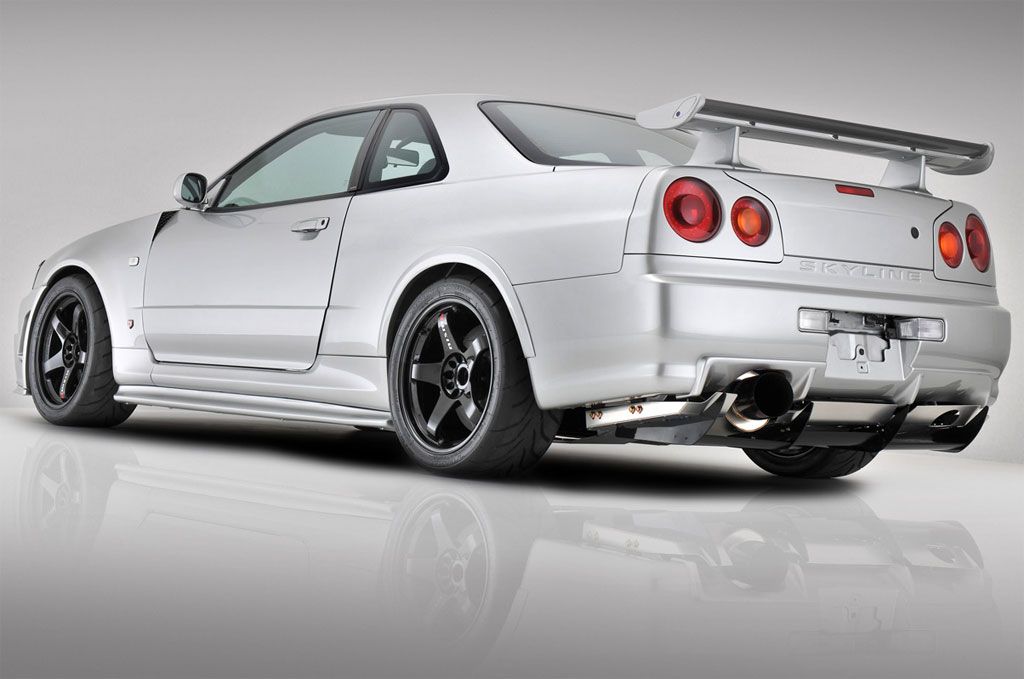
The factory has shown the way: on the occasion of the 20th anniversary of the companys own sports department NISMO (Nissan Motorsports International), in 2004, the Japanese presented a special edition limited to exactly 20 vehicles of the legendary Skyline R34 GT-R, the Å“Z-tune. Since the production of the R34 had been stopped three years before, naturally, there were no brand-new cars of this series available at that time. NISMO 20 therefore purchased 20 used cars with low mileage which they dismantled down to their individual components and then re-assembled completely. Up to today the extremely rare Z-tune is known as the spearhead of the R34 GT-R family and was referred to as Å“the worlds best sports car for a long time - there are many who still do. 


Å“New cars built in 1999 

It is no wonder that JAPO Motorsport GmbH selected this vehicle as the demo object to start a new field of activity: with the specialised restoration of Japanese super sports cars the performance specialists from Essen are opening up new markets - with used vehicles in good condition which, after extensive restoration, almost have the feel of new cars. The individual concept of each project enables the construction of absolute rarities. 

Lets get back the vehicle: JAPO Motorsport bought a used Nissan R34 GT-R (constructed in 1999, chassis no. BNR34000500), took it apart down to its basic structure, followed by an extremely complex rebuilding - closely based on the legendary Z-tune model in terms of technology and appearance. The 100 percent restoration of the high performance coupés took 3.5 months, the result being truly breathtaking. 

Original Z-tune 

Without laying it on thick, original NISMO Z-tune components (front aprons, front mudguards and rear wheel housing) provide the skyline with impressive racing optics. NISMO also offers red rear lights. The expression Å“Technology made visible could not be more fitting for anything but the ARC rear diffuser which purists are especially thrilled about due to its edges and naked metal. Apropos naked metal: the bodywork was completely stripped of paint in the immersion bath, subsequently sealed and painted in the original silver Å“KY0, formerly reserved for the Z-tune. 

HKS-Bi-Turbo-Power 

Without exception, JAPO Motorsport refined the legendary RB26DETT straight six cylinder engine bi-turbo motor with a cylinder capacity of 2.5 litres cylinder capacity using the finest HKS components. To name but a few, two GT RS turbo chargers are now blowing into the cylinders with powerful 1.5 bar boost, sparking off a true hell fire. The intercooler, elbows, half pipe, racing suction and chamber kit, injectors, ignition plugs and cylinder head gaskets are also made by HKS. An HKS Fcon Pro standalone engine management system is responsible for the combustion process. Due to its ARC-4 inch titanium exhaust system, you will already hear the JAPO-Skyline from far. Performance measurement resulted in powerful 523 PS and 597 Nm - on the wheel! 


Traction with the gearbox is enabled due to a considerably resilient HKS clutch. JAPO Motorsport treated the switch box as well as the rear axle differential with additional coolers by ARC for optimised stability. There is no doubt about the HKS Hipermax thread chassis - it has absolute cult status among experts. It is supplemented by an ARC strut mounted between the two front strut pillars, which makes the handling of the coupé even more reliable. 

Semi slicks and classy interior v Real NISMO Z-tune 9.5x18 inch five spoke wheels are rotating in the GT-R wheel housing. Once they are heated, the Toyo Proxes R888 semi slicks in 265/35R18 offer an extremely high level of grip which should however not be tested to the limits by inexperienced drivers. The serial braking system of the R34 GT-R is often scolded. However, after the installation of a stoptech brake with 355/35 millimeter discs and four-piston callipers in front as well as 355/32 millimeter discs and two-piston callipers on the rear axle, JAPOSs Å“new vehicle now offers deceleration values to make the passengers eyeballs bulge. The interior is sporty, classy and not purist at all. JAPO Motorsport installed leather/alcantara fittings for the front and back seats, the dashboard, the centre console, door and side panels, the columns, the roof liner as well as the rim of the Sparco steering wheel. The NISMO tachometer unit is scaled up to 320 km/h, the large multifunctional display above the centre console was extensively updated and now even includes a lap timer. 


2009 Brabus Mercedes E-Class V12 Review


The fourth E V12 generation based on the latest Mercedes E-Class once again sets new standards as the worlds most powerful high-performance sedan. At the heart of this exclusive small-series-production car is the newly developed BRABUS SV12 R Biturbo 800 twelve-cylinder displacement engine. 

With a rated power output of 800 hp (788 bhp) / 588 kW and a peak torque of 1,420 Nm (1,047 lb-ft) this engine catapults the four-door car from rest to 100 km/h (62 mph) in just 3.7 seconds on its way to a top speed of over 370 km/h (230 mph). The exclusively appointed BRABUS E V12 is built in a limited Å“one of ten edition and starts at 498,000 Euros MSRP. 

BRABUS, recognized by the German Federal Vehicle Registration Agency (Kraftfahrtbundesamt) as a vehicle manufacturer, builds the new E V12 Å“one of ten based on the reinforced body of the latest Mercedes E-Class. 

The next evolutionary stage of the proven BRABUS SV 12 Biturbo displacement engine is called SV12 R Biturbo 800 and was developed specifically for this vehicle. The engine is implanted into the modified engine bay of the E-Class with almost surgical precision. 

Displacement of the twelve-cylinder engine that usually powers the latest Mercedes 600 models is increased from standard 5.5 to 6.3 liters (336 to 384 cu. in.). The increase is affected with a special crankshaft with longer stroke, precision-balanced pistons rods and pistons with a larger diameter and an increased cylinder bore. The inner workings of the BRABUS engine are further modified with special sport camshafts and cylinder heads optimized for mixture flow. 

Both the air intake and the BRABUS twin-turbo system were newly developed for this car. The latter features two custom manifolds with integrated high-performance turbochargers and four water-to-air intercoolers. The combustion air is provided by a carbon-fiber RAM-air intake system in the hood. In addition a high-performance exhaust system with free-flow metal catalysts was custom-developed for the platform of the new E-Class. 

New engine electronics with specially programmed mapping for injection and ignition ensure not only exemplary power yield but also compliance with the strict EURO IV emission limits. The high-tech lubricants for the entire drivetrain are supplied by technology partner ARAL. 

With these modifications the engine of the BRABUS E V12 Å“one of ten produces an enormous power output of 800 hp (788 bhp) / 588 kW at 5,500 rpm and an even more impressive peak torque of 1,420 Nm (1,047 lb-ft), available at a low 2,100 rpm. In the car peak torque is limited electronically to 1,100 Nm (811 lb-ft). 

Power is transferred to the rear wheels via a reinforced five-speed automatic transmission and a BRABUS high-performance limited-slip differential with a locking rate of 40 percent. The BRABUS E V12 comes standard with state-of-the-art driving stability programs that can be deactivated at the push of a button. 

Following the tradition of the first three BRABUS E V12 sedans the 2010 edition once again delivers driving performance normally reserved for only a very few select super sports cars. The sedan, which weighs in at 1,980 kilograms (4,365 lbs), sprints from rest to 100 km/h (62 mph) in just 3.7 seconds. After just 9.9 seconds the four-door car reaches a speed of 200 km/h (124 mph). The 300-km/h (186-mph) mark is reached after just 23.9 seconds. Top speed is more than 370 km/h (230 mph) but is limited electronically for reasons of tire safety to 350 km/h (217 mph). 


This extreme performance also places highest demands on the vehicles aerodynamic properties. The BRABUS designers went into the wind tunnel to develop a body conversion kit made from high-strength yet especially lightweight carbon fiber. It not only adds 36 millimeters (1.4 inches) to the width of the E-Class and gives it an even more striking appearance; it also minimizes aerodynamic lift on front and rear axle. 

The BRABUS front was designed to replace the original apron and provides radiators and front brakes with an optimal supply of cooling air. At the same time the sophisticated shape notably reduces aerodynamic lift on the front axle. 

Air vents located behind the wheel arches were integrated into the front fenders. They are also vital to the thermal health of all components in the engine bay and help vent the front wheel houses to reduce lift on the front axle. 

The rocker panels route the air stream to the rear wheel arches with minimum turbulence. The rear wheel arches of the Å“one in ten edition feature special cowlings called Speed Spads. 

The striking rear of the new BRABUS E V12 sets itself apart with the four characteristic tailpipes of the BRABUS high-performance exhaust system. Also part of the sophisticated aerodynamic-enhancement concept is the rear wing on the trunk lid and the diffuser integrated into the rear apron. 

A wider track means better directional stability at high speeds. The widened fenders front and back make room for BRABUS Monoblock Q wheels in size 9.5Jx19. The high-performance tires so essential for these extreme speeds are supplied by technology partners Pirelli and YOKOHAMA. They are mounted on the front axle in size 255/35 ZR 19 and in size 285/30 ZR 19 in back. 

The height-adjustable BRABUS coil-over suspension was also custom-developed for the E V12. The ride height of the suspension can be adjusted to the owners individual preferences. But thats not all: Compression and rebound rates of the front and rear dampers can be adjusted in ten steps between very comfortable and extremely firm for use on the racetrack. Sport sway bars reduce body roll in fast corners. 

The enormous performance of the BRABUS E V12 also places highest demands on the brakes. The high-performance sedan is equipped with 12-piston aluminum fixed calipers and vented and grooved steel brake discs measuring 380 x 37 millimeters (15.0 x 1.5 inches) on the front axle. The rear axle stops on six-piston aluminum fixed calipers gripping discs measuring 360 x 28 millimeters (14.2 x 1.1 inches). The BRABUS high-performance brake system incorporates all functions of the standard Brake Assist system of the Mercedes E-Class. 


The interior of the car exudes a feeling of true exclusive luxury. The sporty-contoured custom front seats and the two rear individual seats are covered with a combination of Alcantara and black leather, smooth or perforated, as are dashboard, door trim and headliner. The entire vehicle floor is covered with square-patterned leather. It alone uses several miles of the finest thread, every inch of it sewn with utmost precision. 

The ensemble is completed with matte-black carbon-fiber components for dashboard, center console and door panels. The BRABUS E V12 Å“one of ten can be optionally equipped with a cell phone from premium manufacturer Vertu. This exclusive cell phone from the Å“Vertu Ascent Ti Carbon Fibre limited edition of 1,500 phones features a titanium housing with the sides clad in black carbon fiber. This especially exclusive phone features 3G and quad-band technology as well as an integrated hands-free option, and represents state-of-the-art communication technology. 

Only ten BRABUS E V12 sedans of the œone of ten edition will be built by hand in a small-series production run. Alternatively the BRABUS E V12 is also offered in a version with 750 hp / 552 kW and a pointedly subtle bodywork without cowlings and rear wing.

Body 
4-door sedan based on Mercedes-Benz E-Class, model series W 212. 
Unibody, with BRABUS fender flares and steel body widened by 36 millimeters (1.4 inches). BRABUS E V12 Å“one of ten carbon-fiber aerodynamic-enhancement kit with front apron, air vents in front fenders, speed spads wheel-house cowlings, rear spoiler lip and rear diffuser. BRABUS hood with integrated RAM-air system. 


Dimensions: 
Wheelbase 2,760 mm " 108.7 in. 
Length 4.891 mm " 192.6 in. 
Width 1.908 mm " 75.1 in. 
Height 1.422 mm " 56.0 in. 
Curb weight 1.980 kg " 4,365 lbs. 
Gross vehicle weight 2.390 kg " 5,269 lbs. 
Fuel tank/reserve 80 l / 9.0 l " 21.1 gal. / 2.4 gal. 

Engine 
BRABUS SV12 R Biturbo 800 displacement engine based on Mercedes 600. 
V12-cylinder 3-valvel light-alloy engine with two turbochargers 
Displacement 6,233 cm³ 
Compression ratio 9.0 : 1 
Rated power output 800 hp (788 bhp) / 588 kW at 5,500 rpm 
Torque 1,420 Nm (1,047 lb-ft) from 2,100 rpm (electronically limited to 1,100 Nm / 811 lb-ft) 
Fuel Super plus (98 ROZ) / Premium gasoline 98 octane 
Motor oil: ARAL 

BRABUS SV12 R Biturbo 800 engine conversion consists of: 
Displacement increase to 6.3 liters with special crankshaft with longer stroke and larger cylinder bore and corresponding pistons. Inlet and outlet ports of both cylinder heads optimized for mixture flow including installation of special camshafts. BRABUS SV12 R Biturbo 800 system with two high-performance turbochargers and special exhaust manifolds with integrated turbine housings, four water-to-air intercoolers and special air intake tract. BRABUS stainless-steel high-performance exhaust system with free-flow metal catalysts. Newly programmed mapping for engine electronics and on-board diagnostics. 
Powertrain 
RWD, ESP 
Reinforced five-speed automatic transmission 

Gear ratios 
1st gear 3.59 
2nd gear 2.19 
3rd gear 1.41 
4th gear 1.00 
5th gear 0.83 
Reverse gear 3.16 

BRABUS limited-slip differential with locking rate of 40 percent 
Final drive ratio either 2.65 : 1 (V/max 315 km/h / 196 mph) or 2.24 : 1 (V/max more than 370 km/h / 230 mph), electronically limited for use on public roads to 350 km/h / 217 mph). 

Front axle: 
Three-link axle, anti-dive geometry. Height-adjustable BRABUS struts with coil springs and gas-pressure shocks with ten selectable settings for compression and rebound, BRABUS sport sway bars. 

Rear axle: 
Multi-link suspension. Anti-squat and anti-dive geometry. Height-adjustable BRABUS struts with coil springs and gas-pressure shocks with ten selectable settings for compression and rebound, BRABUS sport sway bars. 

Wheels: 
BRABUS Monoblock Q light-alloy wheels with Pirelli or YOKOHAMA high-performance tires. 
Front: 9.5J x 19 H2 with size 255/35 ZR 19 tires 
Rear: 9.5J x 19 H2 with size 285/30 ZR 19 tires 

Brake system 
Dual-circuit brake system with Brake Assist and BRABUS high-performance brakes 
Front: BRABUS 12-piston aluminum fixed calipers and vented and grooved steel discs measuring 380 x 37 mm (15.0 x 1.5 inches) 
Rear: BRABUS six-piston aluminum fixed calipers with vented and grooved steel discs measuring 360 x 28 mm (14.2 x 1.1 inches) 

Performance 
0 - 100 km/h (62 mph): 3.7 sec. 
0 - 200 km/h (124 mph): 9.9 sec. 
0 - 300 km/h (186 mph): 23.9 sec. 

Top speed: More than 370 km/h / 230 mph (for tire safety reasons limited electronically for use on public roads to 350 km/h / 217 mph)

Monday, September 20, 2010

FORD FOCUS WRC 2006,2007,2008


The Ford Focus RS WRC is a car built for the BP Ford World Rally Team by Ford and M-Sport and based on the Ford Focus Climate 2 litre production hatchback, developed to compete in the World Rally Championship. The RS stands for Rallye Sport and the WRC for World Rally Car, the car's FIA specification.
Like all contemporary World Rally Cars, the car is heavily modified from the production version, with which it shares only the basic shape and some parts of the bodyshell. The car features four wheel drive, rather than the front wheel drive of the road car. The engine used in the 2007 Focus WRC is based on Ford's 2.0 Litre Duratec from other models in the Focus range as rallying rules do not permit the standard 2.5 Litre engine of the Focus ST or road going RS. As with most rally cars, the 2.0 Litre engine is heavily modified and performance was increased using a turbocharger. Also the 2009 Ford Focus WRC uses a Ford 1998cc Pipo built l4 Duratec WRC engine. Four Cylinders, 16 Valves, Bore 85 mm and Stroke 88 mm. Pi electronic engine Management system. Garrett Turbocharger (with required 34 mm inlet restrictor). Air Intercooler. and a Catalytic Converter.
Power is 300bhp at 6000rpm and 550 Nm of Torque at 4000rpm
Transmission is a Permanent four - wheel drive with M - Sport designed active Centre Differential. Pi electronic differential control Units. M - Sport / Ricardo Five - Speed sequential gearbox with electro - hydraulically controlled shift. M - Sport / Sachsmulti disccarbon Clutch
Suspension is Front and Rear: Macphreson struts (front)and Trailing Arm (Rear) with Reiger external reservoir dampers adjustable in bump and rebound. Fully Adjustable fabricated steel links.
Brakes are 300 mm Brembo ventilated discs with Brembo four-piston monoblock calipers for Gravel.
Weight is a minimum of 1230 kg
Wheelbase is 1800 mm
Length is 4362 mm
Width is 1800mm
Tyres are Pirelli 650 mm for Gravel [1]


The first version of the car was built in 1999 to replace the Ford Escort WRC. It debuted in the Monte Carlo Rally with Colin McRae and Simon Jean-Josephbehind the wheels of the two cars. It was immediately on the pace, setting many fastest stage times, but the use of an illegal water pump meant that the two cars were excluded from the event. McRae gave the Focus its first win two events later on the Safari Rally Kenya finishing over 15 minutes ahead of the second placed Toyota of Didier Auriol.
In 2003, Ford released a newly designed Focus WRC, named Focus RS WRC 03, for competition during the second part of the season. The car, with most parts redesigned from the ground up, featured a lighter body shell and a new aerodynamically enhanced front bumper and wing. Markko Märtin drove the car to two world rally victories. The 2004 and 2005 Focus WRCs were evolutions based on the RS WRC 03. The Focus RS WRC 04 won three events with Märtin at the wheel. By 2005, the car was no longer very competitive and Ford had a winless season.
From the last rally of the 2005 season, Ford campaigned a brand new model, the Focus RS WRC 06, following the launch of the new road-going version of the car. The engine chosen for this Focus was a Duratec motor developed by the French engine specialist Pipo Moteur.[2] The car took twelve world rally wins, starting with the 2006 season opener Monte Carlo Rally in the hands of Marcus Grönholm.
The Focus RS WRC 07 is based on the 2006 model, and according to Ford's technical director Christian Loriaux "the changes on the new car are mainly to save weight and to improve efficiency, driveability and performance at the bottom end of the range."[3] The car debuted very successfully at the 2007 Rally Finland as Ford's Finns Grönholm and Mikko Hirvonen finished in first and second. It later made history at the 2008 Swedish Rally when Jari-Matti Latvala used the car to become youngest-ever driver to win a world rally.